
Description
For centuries, Piazza San Secondo has been the heart of Asti. Once the city’s market square, it is a place where religious and civic authority meet in a unique architectural dialogue. Overlooking the square are the Collegiate Church dedicated to the city’s patron saint and the Town Hall, two enduring symbols of Asti’s identity.
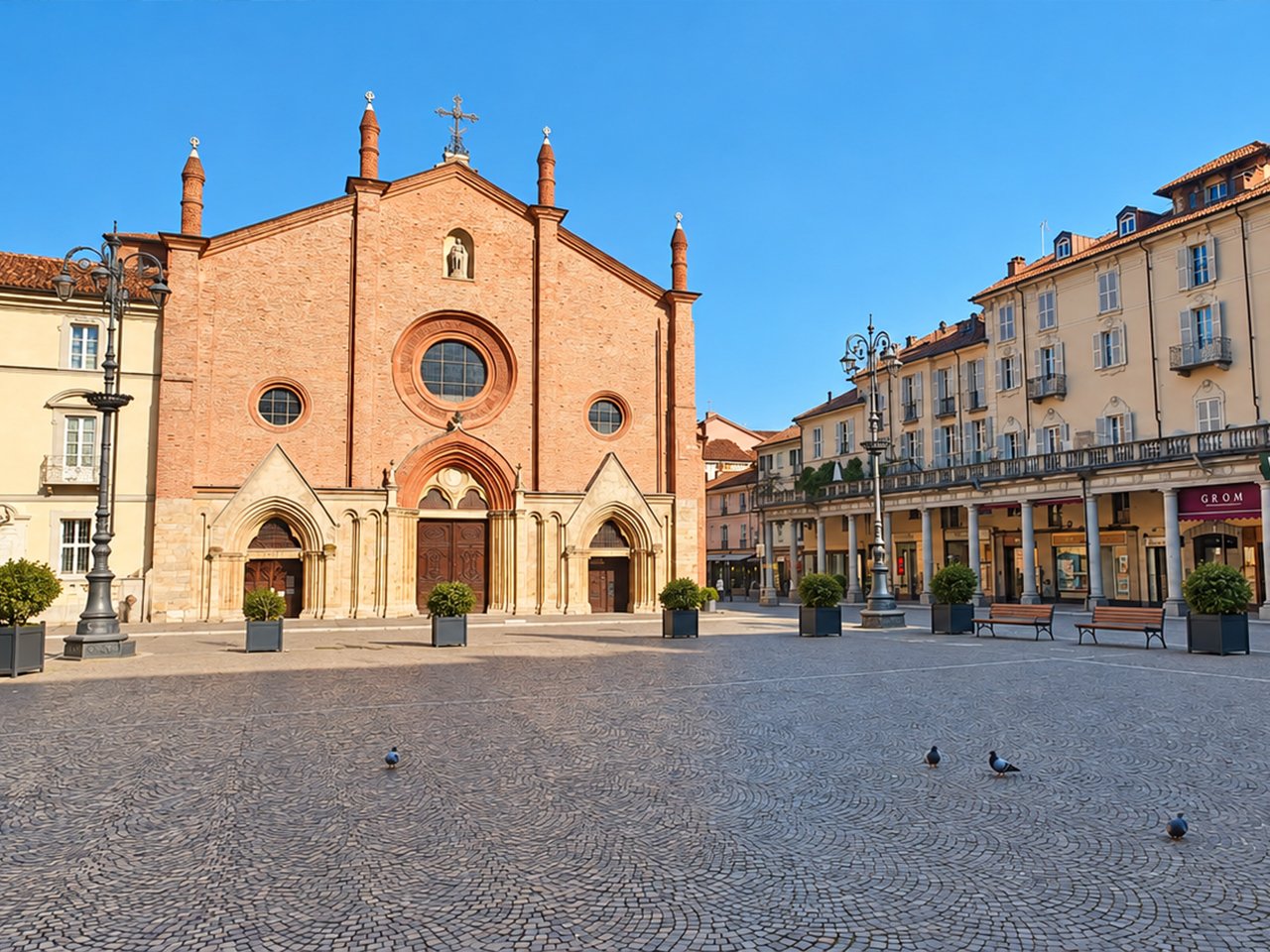
According to tradition, the Collegiate Church of San Secondo stands on the site where the city’s patron saint was martyred in AD 119. Originally a cemetery church outside the city walls, it became known during the Middle Ages as “San Secondo dei Mercanti” — Saint Secundus of the Merchants. This name recalls the powerful merchant families whose donations helped finance its construction and whose coats of arms can still be seen on the capitals.
The terracotta gabled façade dates from the mid-fifteenth century, while the rest of the building was constructed during the thirteenth and fo urteenth centuries.
Inside, the church is divided into a central nave and two side aisles by clustered piers crowned with sandstone capitals. These support pointed arches and groin vaults. The crypt houses the remains of the patron saint in a sixteenth-century silver reliquary. The bell tower and the oldest section of the crypt still preserve the austere character of an earlier Romanesque church, probably dating from the tenth century.
Beside the church rises the Town Hall. Asti’s first municipal building dating back to the late twelfth century. Around 1250, the palatio novo comunis, or new municipal palace, was constructed, traces of which survive in the present wing.
The building was donated by Emanuele Filiberto of Savoy in 1558 and remodelled in the Baroque style by Benedetto Alfieri between 1726 and 1730. Particularly noteworthy are the grand staircase and the painted decorations created by Ottavio Baussano in 1935.
At the entrance is the so-called “reference stone”, a medieval standard used to check the dimensions of bricks and curved roof tiles.
A short distance away stands the Palazzo del Podestà. Probably dating from the thirteenth century, this red-brick fortified residence served as a municipal building and hosted meetings of the city council until 1558.
With its terracotta friezes and round-arched windows, it is the last surviving part of a larger complex and a remarkable reminder of Asti’s glorious medieval past.