
Description
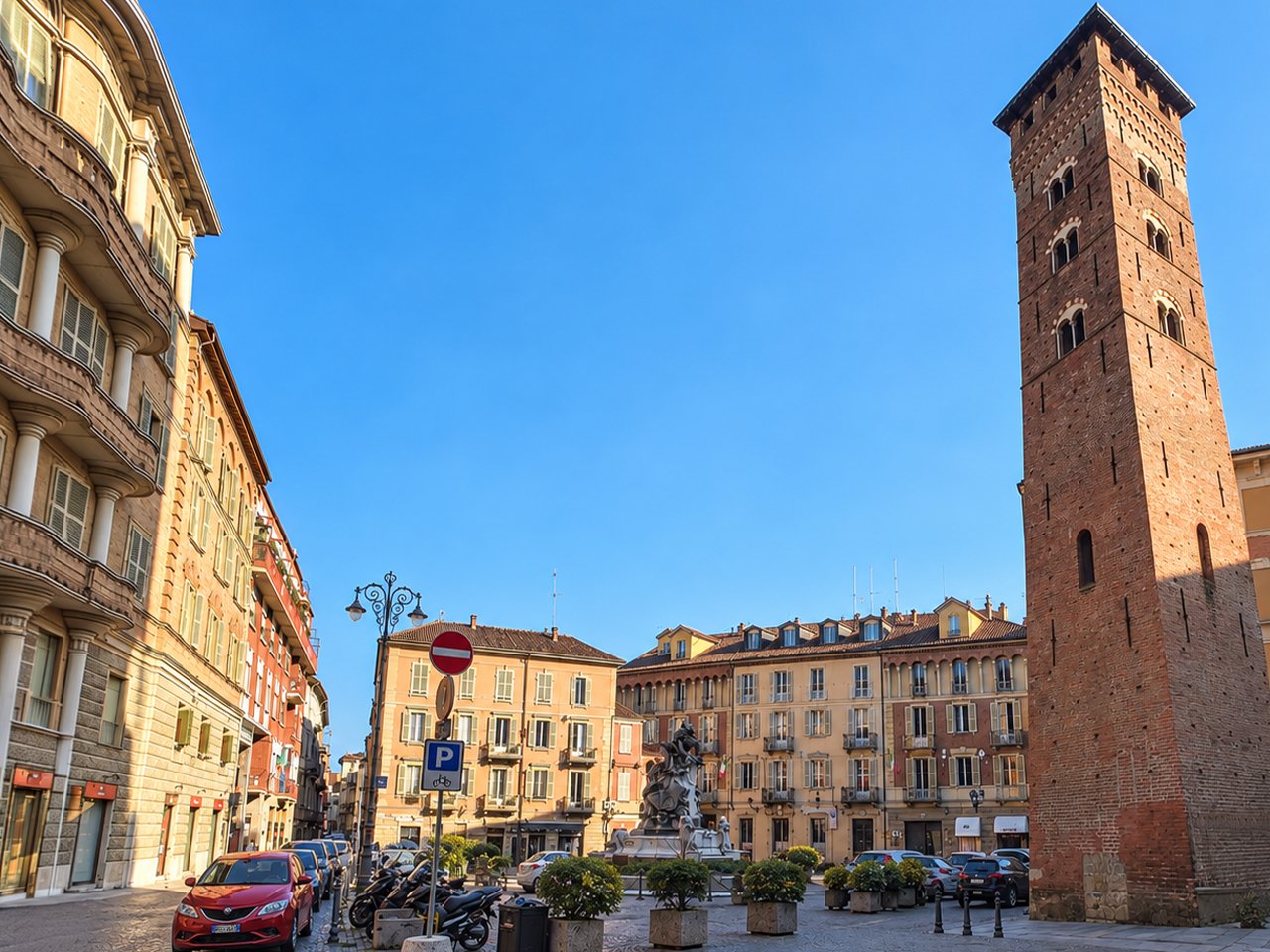
Elegant and intimate, Piazza Medici is an essential stop for anyone seeking to discover Asti's medieval character. The now-lost Church of the Piccola Annunziata once stood here, beside the Torre Troyana. Today, the square is dominated by two of the city’s landmarks: the imposing medieval tower and the striking fountain at its centre.
The Torre Troyana is one of the best-preserved medieval buildings in Asti. Its origins may be linked to the Cortesi family and date from between the late twelfth and early thirteenth centuries. Its history changed significantly around 1250, when it passed into the possession of the Troya family.
The Troya demolished the adjoining palace to build a new residence, but preserved the tower, adding three storeys with elegant mullioned windows. The structure was completed with a decorative crown of small blind arches and distinctive Ghibelline swallow-tailed battlements.
Towards the end of the fourteenth century, the tower was incorporated into the Ducal Palace. It remained connected with the fortunes of the Troya family until the complex eventually passed to the Duke of Savoy.
A decisive moment came in 1560, when Emanuele Filiberto of Savoy donated the complex to Federico Asinari, Count of Camerano, while reserving the use of the tower for the Municipality. A public clock and civic bell were subsequently installed there. The present bell, cast in 1531, replaced an earlier one that had been melted down to make a cannon.
Following restoration work in the late 1990s, the tower once again became accessible. Rising to a height of 44 metres at the top of its lantern, it now offers exceptional panoramic views and remains one of the finest symbols of medieval Asti.
At the centre of the square, on the site formerly occupied by the Piccola Annunziata, stands a monumental fountain. It was created in the late nineteenth century by the sculptor Materno Giribaldi, based on a design by Marquis Luigi Medici del Vascello.
The fountain commemorates the construction of Asti’s public aqueduct, completed in 1890 with financial support from the Medici del Vascello family. Its granite base represents a rocky outcrop, upon which a vigorous young man appears to master a powerful jet of water. The figure is an allegory of human ingenuity and the ability to harness the force of nature.
At the foot of the monument, four basins decorated with female faces, flowers and shells complete the composition.